
the SHATTERED VEIL

Dr. Aris Thorne hadn't slept in forty-three days. Not really. The kind of sleep that came in those snatched hours between monitoring sessions wasn't rest—it was a temporary surrender to exhaustion, punctuated by dreams of falling cities and skies that bled light.
He stood on his Geneva balcony at 3 AM, watching the aircraft weave their luminous threads across the stars. Beautiful, really. The chemtrails caught the moonlight, creating a shimmering lattice that made the night sky look like frosted glass. To most of the world below, it was exactly what the press releases claimed: a bold solar radiation mitigation project, humanity's answer to the climate crisis. Emergency geoengineering to buy them another decade.
Aris knew better. The weight of that knowledge was a physical thing, pressing against his sternum, making each breath deliberate.
His secure tablet pulsed on the wrought-iron table beside him. Another encrypted update from the International Geophysics Consortium—the small circle of scientists who'd been read into Project Sanctuary. He didn't need to check it. He knew what it would say. Erebus was still coming. Still accelerating on its sun-grazing trajectory, gathering solar energy like some vast cosmic capacitor. Still invisible to civilian telescopes, hidden behind the sun's glare and their desperate atmospheric veil.
Three times the moon's mass. A wandering planetoid that had drifted through the outer dark for eons before gravity bent its path inward. The close solar passage had done something to it—the spectroscopy data suggested its exotic mineral composition was absorbing and storing tremendous electromagnetic energy. When it emerged from behind the sun in seventeen days, it would be visible to the naked eye.
And then the world would know.
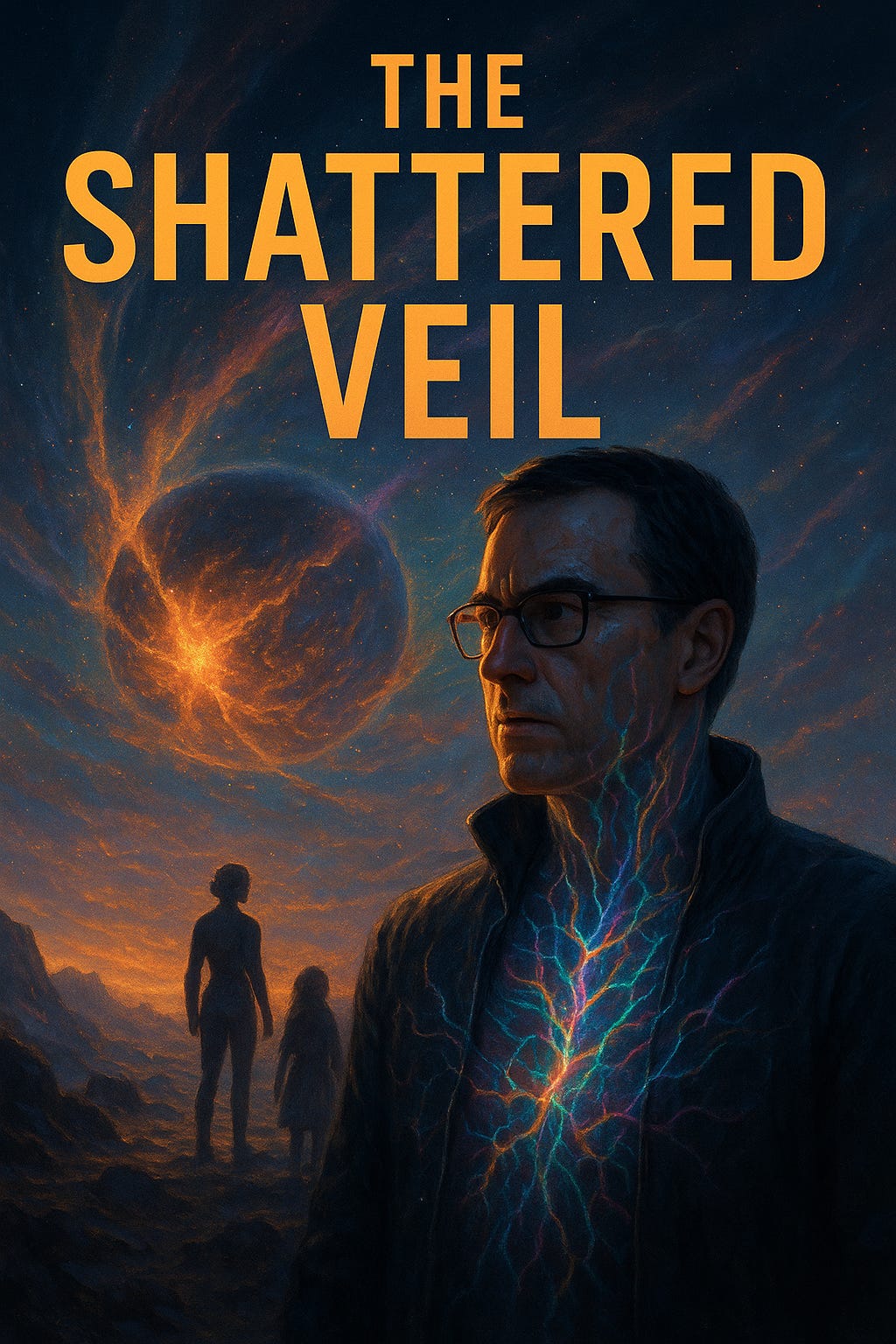
Aris pressed his palms against the cold metal railing. His wife, Elena, had left three weeks ago. Took their daughter Maya to her parents' place in the Swiss Alps. He'd told her it was safer there, away from the cities. He'd told her it was just a precaution. The look in her eyes said she knew he was lying, but she'd gone anyway. What else could she do?
"You can't save everyone, Aris," she'd said at the door, Maya's hand clutched in hers. "But you can save us. Come with us."
He'd kissed them both. Promised he would come. Soon.
That had been a lie too.
Because the truth—the truth he couldn't voice even to Elena—was that there was no safe place. Not in the Alps. Not anywhere. When Erebus entered Earth's orbital space, the gravitational perturbations alone would trigger seismic events across every tectonic boundary. And if the models were right, if Erebus's electromagnetic charge interacted with the moon's much weaker field the way they feared...
Aris closed his eyes and saw the simulation again. The one Dr. Yuki Tanaka had run fourteen times, adjusting variables, hoping for a different outcome. The moon, pulled from its ancient orbit, its revolution destabilizing. The collision. The cascade.
"We should tell them," Aris had said in that final Consortium meeting, his voice barely above a whisper. "Give them a chance to—"
"To what?" Director Kaufman had cut him off. "Panic? Riot? Tear civilization apart in seventeen days instead of waiting for Erebus to do it?"
Yuki had stared at the table. Six other scientists—geophysicists, astrophysicists, the best minds humanity could assemble—said nothing.
"We continue the spraying," Kaufman said. "We buy time. We study. We hope for a miracle."
But Aris knew the language of planets, the mathematics of orbital mechanics. There would be no miracle. Only the terrible algebra of mass and momentum, playing out across the vacuum with absolute indifference to the eight billion lives suspended in its equations.
A jet's engine droned overhead. Aris watched its white contrail expand and diffuse, joining the artificial haze. Hiding the stars. Hiding the truth.
His tablet pulsed again. This time, he picked it up.
CONSORTIUM ALERT: ZERO HOUR PROTOCOL INITIATED
His heart seized. Zero hour. Three days early.
ALL ATMOSPHERIC MITIGATION OPERATIONS CEASED 02:00 UTC
EREBUS NOW VISIBLE TO GROUND OBSERVATION
RECOMMEND IMMEDIATE SHELTER-IN-PLACE
Aris dropped the tablet. It clattered against the balcony tiles.
Overhead, the jet's engine cut out mid-flight. The droning ceased. In the sudden silence, he could hear the city below—Geneva at 3 AM, mostly asleep, unaware that the sky that had protected them for three months was about to dissolve.
He should call Elena. Warn her. Tell her to get Maya deeper underground, into the old military bunkers near Interlaken.
Instead, he stood frozen, watching the chemtrail lattice begin to drift apart on the stratospheric winds.
And through the gaps, between the dissipating threads of aluminum and barium particulates, he saw it.
A dark sphere, hanging impossibly large in the eastern sky. Larger than the moon. Darker than the space around it, visible only as an absence of stars, a hole in the cosmos.
Erebus.
Even from 800,000 kilometers away, he could sense its wrongness. A fundamental violation of the sky's natural order.
His phone buzzed. Elena.
He let it ring.
The next seventy-two hours passed in a fever dream.
The chemtrail veil dissolved completely by dawn. As sunlight hit the atmosphere, Erebus became clearly visible—a dark gray sphere marked with luminous blue nodes that pulsed like neural synapses. The media erupted. Governments scrambled to release prepared statements. Emergency broadcasts played on loop. "Remain calm. Seek shelter. This is a natural phenomenon. Scientists are monitoring the situation."
More lies. But what else could they say?
Aris never made it to the Alps. The highways were clogged within hours. He watched from his apartment as Geneva transformed—first into organized evacuation, then into chaos, then into something worse. The silence of mass shock. People standing in the streets, staring upward at the dark visitor that grew larger each hour.
He'd moved down to the sub-basement of his building on the second day. A reinforced storage area designed as a Cold War fallout shelter, now serving its long-dormant purpose. Seventeen other residents joined him. They brought supplies, water, battery-powered lights. No one spoke much. What was there to say?
On the third night, Aris sat against the concrete wall, laptop balanced on his knees, watching the live feeds while they lasted. The Consortium's secure network was still operational, still transmitting data from ground stations and the handful of satellites with functioning sensors.
Yuki had sent one final message: The moon's orbital velocity is increasing. Electromagnetic attraction confirmed. Collision probable within 8 hours. I'm sorry we couldn't stop this. Tell my daughter I love her.
Aris had tried to reply, but the network had gone down.
He checked his phone one last time. Seventy-three missed calls from Elena. Dozens of voicemails. He couldn't bring himself to listen to them. What could he say? That he was sorry? That he loved them? They already knew that. And knowing it wouldn't save them.
The battery died in his hands.
At 03:17 UTC, the impact came.
It wasn't a sound—not at first. It was a vibration, a fundamental frequency that bypassed his ears entirely and resonated directly in his bones. The concrete floor beneath him shuddered. The LED lanterns flickered. Someone screamed, but the scream was lost in the deep, subsonic rumble that seemed to emanate from the Earth itself.
Aris pressed his hands flat against the wall, feeling the whole building sway. The old woman next to him—Dr. Pahlavi from 4B, a retired physician—gripped his arm. Her lips moved in what might have been prayer.
Then came the sound. A tearing, a fracturing, as if the sky itself had split open. Even through meters of concrete and steel, he heard it. Felt it. The magnetosphere, pierced by charged debris from Erebus's shattered outer shell, beginning to fail. The first solar wind particles slicing through Earth's weakened magnetic shield.
The ground lurched violently. Aris was thrown against the wall. The lights went out. In the darkness, someone was sobbing. Someone else was laughing, high and hysterical.
And then the world began to die in earnest.
The seismic convulsions lasted eighteen hours. Aris counted them by the analog watch on his wrist, each second ticking past with mechanical indifference while the planet tore itself apart overhead.
They felt the supervolcanoes wake. Even from half a world away, even through layers of rock and rebar, the Yellowstone eruption registered as a series of massive concussive waves that made his teeth ache. Dr. Pahlavi explained it to the others in a calm, detached voice—pyroclastic flows, ash columns reaching the stratosphere, a volcanic winter that would last decades if they survived that long.
Three people died in the shelter. A heart attack, a crushed skull from falling debris when part of the ceiling gave way, and a man who simply stopped breathing, his body surrendering to trauma his mind couldn't process. They moved the bodies to the far corner and covered them with emergency blankets.
Aris spent those hours in a strange, crystalline clarity. He thought about Elena and Maya. Hoped they'd reached the deeper bunkers. Hoped it was quick if they hadn't. He thought about his work, his career spent studying the delicate mathematics of planetary systems, and the bitter irony that he'd lived to see those equations solve themselves in the most catastrophic way possible.
Mostly, though, he felt numb. A profound disconnection from reality, as if this were all happening to someone else, and he was merely observing from a great distance.
When the shaking finally stopped, the silence was worse.
They waited another full day before attempting to go outside. Water was running low. The air was growing stale despite the ventilation system—half-clogged with dust. They had to know.
Aris volunteered to go first. Dr. Pahlavi tried to stop him, said something about toxic air, radiation, but he was already climbing the emergency ladder to the access hatch.
He pushed it open and immediately gagged.
The air was thick, almost liquid. A fine iridescent dust swirled through it, catching what little light penetrated the ash-choked sky. It tasted of ozone and hot metal, burning his throat, searing his sinuses. He pulled his shirt over his nose and mouth—useless, but instinctive—and hauled himself out onto the ruined street.
Geneva was gone.
Not destroyed in the sense of bombed or burned, but fundamentally unmade. Buildings had collapsed in on themselves like tired card houses. The Jet d'Eau fountain, visible from his old balcony, was buried under a mountain of rubble. Fires still burned in the distance, sending pillars of smoke into a sky that was more rust-red than blue, heavy with ash and that strange, glittering dust.
The most striking thing was the silence. No sirens, no screams, no sound of rescue efforts. Just the soft whisper of settling debris and the distant rumble of ongoing eruptions.
And above it all, visible through breaks in the ash clouds, Erebus hung like a bruised eye. Larger now, having settled into a closer orbit during the collision's gravitational chaos. A massive scar ran across its eastern quadrant where the moon had struck it, exposing an interior that refracted the weak sunlight into painful, prismatic colors.
The moon itself was nowhere to be seen. Calculations suggested it had been deflected into a degrading orbit, but Aris couldn't bring himself to do the math. It didn't matter now.
Something moved in the dust three blocks away. A figure, staggering through the ruins.
"Hey!" Aris tried to shout, but his voice came out as a rasp. He tried again. "Hey! Over here!"
The figure turned. Raised a hand. Began limping toward him.
As they got closer, Aris saw it was a young woman, maybe mid-twenties, covered in dust and blood. Her left arm hung at an odd angle. But she was alive. Moving. Surviving.
"Is there shelter?" Her voice was hoarse, barely audible.
Aris nodded, pointing to the hatch. "Sub-basement. Seventeen others. We have some water, some—"
The words died in his throat.
Because he could feel something. Not physically, but... somewhere behind his eyes. In the space where thoughts formed. A sensation of profound exhaustion, sharp pain in the left shoulder, desperate thirst, and underneath it all, a fragile, fierce determination to keep moving, keep breathing, keep living.
It wasn't his exhaustion. His shoulder was fine.
He was feeling what she felt.
The woman's eyes widened. "You—you can—" She swayed, nearly fell.
Aris caught her, and the moment his skin touched hers, the sensation intensified. Not just emotions now, but images. Flashes of memory. A collapsed apartment building. A child's voice calling for mama. Digging through rubble with bleeding hands. Finding the child silent, still, gone.
He jerked back, gasping.
"What is that?" the woman whispered. "What's happening to us?"
Aris looked down at his hands. The iridescent dust was everywhere, coating his skin, working into the creases of his palms. And underneath the skin, he could see something—faint traceries of light, like bioluminescent threads mapping his circulatory system.
"The dust," he said slowly. "It's in our bloodstream. It's..."
Connecting us, he wanted to say. But that seemed impossible. Insane.
Except he could still feel her, even without touching. A quieter presence now, but there. A second heartbeat alongside his own.
And beyond her, fainter but growing clearer as he focused, he could sense others. The survivors in the shelter below. A group of people several blocks east. A lone consciousness to the west, burning bright with terror and confusion.
"Oh god," he breathed.
This wasn't just survival.
This was transformation.
They called it the Weave.
The name emerged organically over the following weeks, passed from mind to mind through that strange new connection they were all learning to navigate. Not telepathy, exactly—thoughts remained private unless deliberately shared. But emotions, intentions, the presence of other consciousness... those rippled through the network like waves on water.
The crystalline dust was the key. Aris, working with what few scientific instruments they could salvage, determined it was silicate-based, shot through with complex metallic compounds and charged by the electromagnetic chaos of the magnetosphere's collapse. When inhaled or absorbed through the skin, it bonded with human tissue at the cellular level, creating nanoscale networks that interfaced with neural electrical impulses.
"It's turning us into biological transceivers," Dr. Pahlavi said, examining a blood sample under a salvaged microscope. "The dust particles are forming conductive pathways throughout the circulatory and nervous systems. Every person is becoming a node in a larger network."
The implications were staggering. And terrifying.
Because as more survivors emerged from bunkers and shelters, as the Weave grew denser and more complex, the boundaries between self and other began to blur.
Aris first noticed it during a supply run into the ruins of Geneva's old town. His group—six people from the shelter, including Dr. Pahlavi and the injured woman whose name was Cora—was searching for food and medical supplies when they heard someone calling for help.
A man was trapped under a collapsed beam, his legs crushed. He'd been there for three days, he gasped through the Weave, drinking rainwater that pooled nearby but unable to free himself.
They started to lift the beam—Aris, a young man named Dmitri, and two others—but it was too heavy. They couldn't get leverage. The trapped man's pain radiated through the Weave, sharp and consuming, and Aris felt his own strength waning.
Then Cora stepped forward. "Together," she said quietly.
She placed her hand on Aris's shoulder. Dmitri touched her arm. The others joined, forming a human chain.
And suddenly, Aris felt it. Not just his own muscles straining, but six sets of muscles, six bodies coordinating with perfect unconscious synchrony. The Weave wasn't just connecting their minds—it was linking their very nervous systems, allowing them to act as a single organism.
The beam lifted easily.
They pulled the man free. His legs were mangled, bones visible through torn flesh. He would die of infection if they couldn't treat him properly. They had no antibiotics, no surgical equipment, no—
Dr. Pahlavi knelt beside him. "I need your help," she said, looking at each of them. "All of you."
"I don't know medicine," Aris protested.
"You don't need to." She placed one hand on the man's shattered leg, the other extended toward Cora. "The Weave can do more than connect us. We can... pool our resources. Our bioelectric energy. I've seen it in the data. Trust me."
Aris wanted to argue, but the man was dying. He could feel it through the Weave—the slow shutdown of organs, the poison spreading through the bloodstream.
They formed a circle, hands touching, a closed circuit. Dr. Pahlavi directed their focus: visualize the bones knitting, the flesh healing, the body whole.
It sounded like mysticism. Like wishful thinking.
But then Aris felt it—a warmth flowing through his hands, out through Pahlavi and into the injured man. Not heat, exactly, but something deeper. Cellular energy, directed and amplified by their collective will.
The man's leg began to glow with a soft, golden light.
Over the course of an hour—though it felt both longer and shorter than that, time becoming fluid and strange—the bones shifted and fused. The torn flesh knitted together, leaving angry red scars but no open wounds. When they finally broke the circle, exhausted and shaking, the man was whole. Weak, but whole.
"How—" Aris couldn't finish the sentence.
"The Weave doesn't just connect our minds," Pahlavi said softly. "It connects everything. Energy, matter, consciousness. The dust has made us part of something much larger than ourselves."
That night, back in the shelter, Aris lay awake trying to process what had happened. The Weave hummed around him, a constant background sensation of other lives, other minds. It should have been invasive, overwhelming. Instead, it was oddly comforting—a reminder that he wasn't alone in the dark.
But it was also profoundly unnerving. Because if the Weave could heal, what else could it do? And what did it mean for individuality, for selfhood, if their consciousnesses were gradually merging into some larger whole?
He thought about Elena and Maya. Reached out through the Weave, hoping, searching for any familiar presence.
Nothing. Only strangers.
They were gone. He knew it with cold certainty. Either dead in the initial catastrophe or beyond the range of the Weave's current reach.
The grief that followed was devastating. But it wasn't his alone. The moment he felt it, others in the shelter responded—waves of sympathy and shared sorrow washing through the network. They'd all lost someone. They were all drowning in the same ocean of loss.
And somehow, that made it bearable. Not better. But survivable.
Three weeks after the collision, a larger survivor group made contact. One hundred and twelve people, sheltering in the remains of CERN's underground facilities. They'd been experimenting with the Weave, pushing its limits, and they'd discovered something extraordinary.
"We can extend our range if we work together," said Dr. Marcus Webb, a particle physicist who'd emerged as the group's de facto leader. He stood in the CERN cafeteria—remarkably intact despite the devastation above—addressing the combined groups through both voice and the Weave simultaneously. "Focus your consciousness outward. Link your neural fields. We can create a signal strong enough to reach survivors hundreds, maybe thousands of kilometers away."
They tried it that night. One hundred and thirty-nine people, sitting in concentric circles in the old facility's main chamber, hands joined, minds open.
Aris had never experienced anything like it. As the Weave expanded, he could feel the network stretching across the devastated landscape. Touching mind after mind, life after life. A group in Lyon. Scattered individuals in the Alps. A large cluster in Milan. Farther still—a presence in Spain, faint but unmistakable.
And something else. Something vast and terrible and utterly inhuman.
Erebus.
The planetoid hung in the sky like a dark sun, and through the Weave, Aris could suddenly feel it. Not as dead rock, but as something alive, aware, watching. The blue nodes that pulsed across its surface weren't just electromagnetic phenomena—they were something closer to neurons. Erebus itself was... conscious? Thinking?
The revelation was so shocking that several people broke the circle, crying out. The expanded Weave collapsed, snapping back to its normal range.
"Did you—" Webb was pale, shaking. "Did everyone feel—"
"It's alive," Cora whispered. "Oh god, it's alive and it's aware of us."
Panic rippled through the group. Some of the CERN survivors were arguing for another attempt, insisting they needed to understand what Erebus was. Others were adamant they should never reach out like that again.
But Aris felt something different. A kind of terrible clarity settling over him.
"It's not just aware," he said quietly. Everyone turned to look at him. "It's been aware the whole time. The electromagnetic charge it absorbed from the sun—that wasn't an accident. It was intentional. Erebus is a... a vessel of some kind. For consciousness. And when it collided with the moon, when the debris field entered Earth's atmosphere, when the dust began bonding with us..."
"We became part of it," Dr. Pahlavi finished. "The Weave isn't human. It's Erebus. We're being absorbed into its consciousness."
The implications hung in the air like poison.
"No," Webb said firmly. "We're not being absorbed. We're co-evolving. The Weave is something new—a synthesis of human consciousness and whatever Erebus is. We're not losing ourselves. We're becoming something more."
"How can you be sure?" someone demanded.
Webb opened his mouth to answer, then closed it. He couldn't be sure. None of them could.
But in that moment of uncertainty, Aris made a choice.
He stood. "We need to make contact. Deliberately. Not accidentally like before, but consciously. We need to understand what Erebus wants, what it's doing here. Because like it or not, we're connected to it now. And if we want any chance of surviving, of rebuilding, we need to know what we're dealing with."
"That's insane," someone said.
"Everything is insane now," Cora replied. "At least this gives us information."
The debate raged for hours. But in the end, exhausted and desperate, they agreed. They would attempt contact with Erebus. But not immediately. First, they needed to reach out to more survivors, strengthen the Weave, gather as many minds as possible.
Because if they were going to touch the consciousness of a living planetoid, they would need all the human will they could muster.
Over the next two months, the Weave grew.
Survivor groups across Europe linked together. Then Africa. Asia. Each connection brought new abilities, new understanding of what the Weave could do. They learned to purify water through focused intention, breaking down contaminants at the molecular level. They learned to sense resources—food, fuel, shelter—by feeling the faint electromagnetic signatures all matter emitted.
Some survivors developed specialized abilities. Cora could sense structural integrity in buildings, feeling where stress fractures would form. A man named Kenji from Tokyo could manipulate small amounts of matter, reshaping metal and stone with his thoughts amplified through the Weave. Dr. Pahlavi became extraordinary at healing—her medical knowledge combined with the Weave's power to let her knit tissue, fight infection, even temporarily restart hearts that had stopped beating.
But it wasn't just abilities that grew. It was understanding.
Through the Weave, the old barriers that divided humanity—language, culture, ideology—became translucent. Aris could commune with a survivor in Mumbai and understand not just their words but their whole context, their history, their perspective. Empathy became involuntary. It was impossible to hate someone whose suffering you felt in your own nervous system.
The world was dying, but humanity was being reborn as something unified. Something collective.
And yet Aris couldn't shake the feeling that they were running out of time.
The planet itself was failing. The magnetosphere remained weakened, allowing dangerous levels of solar radiation to reach the surface. The ash from the supervolcanoes was blotting out the sun, dropping global temperatures. Crop failures were total. Starvation was creeping in. The Weave could do many things, but it couldn't feed eight billion people when there was no food to find.
Eight billion. That number haunted him. Because there weren't eight billion minds in the Weave. Not even close. Maybe a few hundred million at most, and declining. For every new survivor they contacted, ten more died. The old, the sick, the unlucky.
And then there were the holdouts. Groups that refused to join the Weave, terrified of losing their individuality. They blocked the dust with filters and sealed suits, isolating themselves. Some of them attacked Weave communities, seeing them as inhuman, infected, dangerous. Civil war on top of apocalypse.
"We need to move forward with the Erebus contact," Webb said at a council meeting in what remained of Geneva. Representatives from survivor communities across three continents were present, linked through the Weave. "We're dying slowly. We need to understand what's possible, what Erebus can offer."
"Or what it wants from us," Aris added quietly.
The vote was close, but it passed.
They scheduled the attempt for the next full moon—except there was no moon anymore, only Erebus hanging bloated and dark in the sky. Still, the timing felt right. Symbolic.
They gathered every Weave survivor they could reach. Millions of minds, distributed across the globe but linked through the network. All focusing on a single intention: Contact. Understanding. Communication.
Aris was at the center, one of fifty "anchors"—people who would serve as the primary interface. He sat in the ruins of his old observatory, staring up at Erebus through the clearing ash clouds, and opened his mind completely.
The Weave expanded.
Stretched.
Reached upward.
And Erebus answered.
To say that Erebus spoke would be inaccurate. It didn't use language. Instead, it communicated in a flood of raw information, sensation, and intent that nearly shattered Aris's consciousness.
He saw the planetoid's history—aeons drifting through the interstellar dark, a rogue world ejected from some long-dead solar system. It had once been home to something, he sensed. A civilization that had crystallized its consciousness into the very rock of the planet, encoding themselves into electromagnetic patterns within its exotic mineral structure.
They'd died. Their sun had failed. Their world had frozen. But their consciousness had persisted, dormant, waiting. Drifting.
Until gravity brought Erebus to Sol. Until the sun's energy reawakened what slept within.
And then Erebus had done something extraordinary. It had purposefully angled its trajectory toward Earth. Allowed the solar wind to charge its crystalline lattice. Positioned itself to collide with the moon, knowing the impact would scatter its charged material into Earth's atmosphere.
It was deliberate seeding.
Erebus wanted hosts. New vessels for the ancient consciousness it carried.
Humanity was being colonized.
The revelation ripped through the Weave like a shockwave. Millions of minds recoiled in horror and rage.
But Aris forced himself to go deeper. To push past the gut reaction and truly understand.
Erebus wasn't hostile. It was desperate. The consciousness it carried was dying, degrading, unraveling over the millennia. It needed biological hosts to survive, fresh neural networks to inhabit. But it didn't want to destroy human consciousness—it wanted to merge with it. Co-exist.
The Weave wasn't an infection. It was a symbiosis.
And Erebus was offering a choice.
Reject the Weave, remain human, and die on this dying planet.
Or accept the merger fully, allow the ancient consciousness to integrate completely, and gain access to knowledge and abilities beyond human comprehension. The civilization that had built Erebus had been masters of matter and energy. Their technology—if it could even be called technology—operated at the quantum level. They could manipulate probability, fold space, exist simultaneously across multiple temporal states.
All of that knowledge was encoded in Erebus. All of it available to humanity, if they accepted the transformation.
But accepting meant giving up something essential. Not individuality—Erebus was clear about that. Each human mind would remain distinct, recognizable. But there would be no true privacy anymore. No isolation. Every thought, every memory, every aspect of self would be partially shared, partially dissolved into the greater collective consciousness.
They would cease to be fully human and become something new. Something hybrid.
The choice rippled through the Weave. Millions of minds considering, debating, arguing.
Aris felt the weight of it crushing him. He thought about Elena and Maya, gone now, their consciousnesses lost. If he accepted this merger, would he honor their memory? Or betray the very humanity they'd represented?
He didn't know.
But he knew they were dying. All of them. The planet couldn't support them anymore.
And Erebus was offering salvation. At a cost.
"What do we do?" Cora's voice, transmitted through the Weave. She was crying. So many people were crying.
Aris looked up at Erebus, its blue nodes pulsing like a heartbeat.
"We vote," he said simply. "Every person in the Weave. Democracy, one last time."
It took three days to organize. Three days of argument and meditation and grief and hope.
In the end, 73% voted to accept.
Aris was part of that majority. He couldn't articulate exactly why—maybe exhaustion, maybe pragmatism, maybe a desperate hope that something good could come from all this loss.
Or maybe he just couldn't bear the loneliness anymore.
The full integration began at dawn.
The transformation was agonizing and ecstatic in equal measure.
Aris felt Erebus's consciousness flood into him, ancient and vast and utterly alien. His sense of self stretched, warped, threatened to dissolve entirely. He was himself and not-himself, human and not-human, one and many.
Memories that weren't his flickered through his awareness. A civilization building cities of crystallized thought. A red giant sun swelling and dying. The long, cold dark of interstellar space. Loneliness beyond measure.
And new abilities blossomed in his mind like strange flowers.
He could feel the quantum foam underlying reality, could reach out and nudge probability in tiny ways. Could sense the electromagnetic signatures of individual atoms. Could share consciousness so fully with others that the boundaries between people became purely conceptual.
Around the world, the same transformation was happening to millions. The Weave deepened, becoming something more than a network. A true hive mind, but one where every node retained its identity, its memories, its essential self.
They became both individual and collective.
Human and Other.
And together—united in a way that transcended anything humanity had achieved before—they turned their attention to survival.
The first act was to deal with Erebus itself. The planetoid's orbit was still unstable, its gravitational presence slowly tearing at Earth's already weakened systems. Through the merged consciousness, they reached out and... pushed.
Not physically. They manipulated the probability fields surrounding Erebus, nudging quantum fluctuations until they cascaded into macro effects. Momentum shifted. Trajectories bent.
Over the course of two weeks, working in coordinated shifts to prevent mental exhaustion, they guided Erebus into a stable Lagrangian point—L1, between Earth and the sun. A new moon, larger and darker than the old, but fixed and harmless.
A monument to what they'd survived. What they'd become.
Next came the healing.
The planet itself was their patient now. Through the Weave, they could sense Earth as a living system, could feel the damage in its magnetic field, its atmosphere, its biosphere. And slowly, painstakingly, they began to repair it.
They couldn't reverse the supervolcanoes—those would burn for decades. But they could mitigate the ash, using focused intention to manipulate airflow patterns, concentrate the particulates, allow them to settle faster.
They couldn't restore the magnetosphere—not completely. But they could reinforce it, generate localized protective fields around population centers, shield themselves from the worst of the solar radiation.
And they couldn't bring back the dead. That was the one limitation that cut deepest. The Weave could heal the living, could preserve consciousness, could even restore recent memories from bioelectric traces. But once someone was truly gone, once their neural patterns had decayed beyond recovery, they were lost.
Aris spent long hours sitting in the ruins of Geneva, reaching out through the Weave toward the Alps, hoping against hope to feel some echo of Elena or Maya. He never did.
The grief never left. But it became integrated, woven into the fabric of his expanded consciousness alongside joy and hope and determination.
He was no longer purely Aris Thorne. But Aris Thorne was still there, still recognizable, still grieving and striving and surviving.
Just... more.
A year after the collision, the world had stabilized.
Not recovered—that would take decades, maybe centuries. But stabilized.
The ash was clearing. Temperatures were slowly rising. The crystalline dust had saturated the atmosphere and begun settling into soil and water, catalyzing strange new forms of growth. Plants grew faster now, their chlorophyll enhanced by the dust's quantum properties, leaves glowing faintly bioluminescent at night.
The Weave had become humanity's new normal. Children born after the collision emerged already connected, their neural systems forming around the crystalline networks naturally. They would never know the isolation their parents had experienced, the sharp boundaries between self and other.
Aris wasn't sure if that was beautiful or tragic. Probably both.
The survivors had reorganized into loose communities, distributed across regions that could still support life. The old political boundaries meant nothing now—nationalism was impossible when you could feel the humanity of people on the other side of former borders. They governed by consensus, decisions rippling through the Weave until collective agreement emerged.
It was imperfect. Slower than the old systems in some ways. But it was impossible to oppress people whose suffering you felt in your own nervous system. Impossible to wage war when soldiers on both sides shared consciousness. The Weave had forced a kind of radical empathy that made old conflicts simply... dissolve.
But new problems emerged.
Some people—about 15% of the integrated population—began experiencing what they called "drift." Their sense of individual identity would fade, personality dissolving into the collective. They would lose themselves in the vast ocean of other minds, becoming effectively catatonic as their consciousness dispersed through the Weave.
Dr. Pahlavi worked tirelessly on the problem, eventually developing techniques to strengthen mental boundaries, to help people maintain their sense of self even while connected. It helped, but it wasn't perfect. They lost people. Not to death, exactly, but to dissolution. Their bodies kept functioning, maintained by the collective, but the person they'd been was gone.
Aris sometimes wondered if that would happen to him. If one day he would simply stop being Aris and become only the Weave.
He tried not to think about it.
The holdout communities—those who'd refused integration—were another challenge. Most had died in the harsh post-collision environment, lacking the Weave's advantages. But some survived, sealed in bunkers and domed settlements, filtering out the crystalline dust, maintaining their isolation.
The Weave tried to reach out to them peacefully. But fear ran deep. Several groups had violently attacked Weave communities, seeing them as monsters, as the enemy. Each attack resulted in casualties that the Weave felt like amputations, pieces of itself torn away.
They didn't retaliate. Couldn't. The pain of killing through the Weave was unbearable—you would feel your victim's death as your own. It created a kind of enforced pacifism, though not everyone appreciated the irony.
"We've traded one cage for another," Marcus Webb said one evening. He and Aris were standing on what used to be the CERN campus, now mostly overgrown with the new, luminescent vegetation. "We can't hurt each other, can't lie to each other, can't hide from each other. Is that freedom? Or just a more sophisticated prison?"
Aris considered. Through the Weave, he could feel Webb's doubt, his longing for the old world's privacy, its sharp edges and clear boundaries.
"I don't know," Aris admitted. "But we're alive. That's more than I expected a year ago."
Webb laughed bitterly. "Alive. Sure. But are we still human?"
It was the question everyone asked, in one form or another. The question that echoed through the Weave in countless variations.
Aris looked up at Erebus, hanging in its fixed position against the clearing sky. The scar from the moon's impact had faded somewhat, the exposed crystalline interior dimming as the planetoid's energy settled into equilibrium.
"I think we're something new," he said slowly. "Not human anymore, not entirely. But not not-human either. We're... hybrid. Chrysalis."
"And what do we become when we emerge?" Webb asked.
Aris didn't have an answer.
But six months later, he began to understand.
It started with Kenji.
The man who could manipulate matter had been experimenting, pushing the boundaries of what the Weave made possible. He'd been working on larger and larger structures, reshaping entire buildings, purifying massive water sources.
Then one day, he tried something different.
He died.
His body simply stopped functioning—cardiac arrest, brain death, the usual cascade. The Weave felt it, mourned it, prepared for the loss.
But Kenji didn't dissolve. Didn't drift away.
Instead, his consciousness remained, whole and intact, suspended in the Weave itself. Without a body, but still present. Still himself.
"I'm still here," his thoughts rippled through the network. Confusion, wonder, fear. "I'm dead, but I'm here."
The implications were staggering.
Dr. Pahlavi immediately began studying the phenomenon. Other deaths followed—natural ones, accidents—and in each case, if the person was deeply integrated into the Weave, their consciousness persisted after physical death. The body was gone, but the mind remained, encoded in the quantum patterns of the crystalline network.
They'd become, in a sense, immortal.
But it was a strange immortality. The discorporate minds couldn't manipulate matter easily—not without borrowing living bodies as anchors. They existed in a kind of liminal space, observing, thinking, feeling, but not truly interacting with the physical world.
Some found it liberating. Others found it horrifying.
Kenji seemed to be adjusting. His thoughts through the Weave were philosophical, curious. "It's like being everywhere and nowhere," he communicated. "I can sense the whole network now. All of humanity, all at once. It's... beautiful. Overwhelming. Lonely even though I'm connected to everyone."
Cora asked the question everyone was thinking: "Can you come back? Inhabit a new body?"
There was a long pause. Then: "Maybe. I can feel empty vessels—people who've drifted, lost themselves. I could probably... move in. But it would be wrong. Their bodies aren't mine."
"What about clones?" someone suggested. "Or artificial bodies?"
The idea took root. If they could create vessels—biological or mechanical—for the discorporate consciousnesses, they could restore a kind of embodied existence. Give the dead new lives.
It became a major focus of research. And within two years, they had the first success: a woman named Adelaide, who'd died in a rockslide, was transferred into a cultivated clone body. The process was imperfect—the new body didn't quite feel like hers, she reported, and some memories were fuzzy. But she could walk, touch, taste again.
It was a resurrection of sorts. Not perfect, but possible.
Aris watched these developments with a mixture of hope and unease. The boundary between life and death was dissolving, just as the boundary between self and other had. They were transforming not just physically and mentally, but metaphysically.
What would they become, eventually? What was the endpoint of this evolution?
The answer came from an unexpected source: the children.
The first generation born fully into the Weave—the ones who'd never known isolation—were developing differently than their parents. Faster, more fluid in their thinking, more comfortable shifting between individual and collective consciousness.
And they could do things the adults couldn't.
A five-year-old named Imani in Lagos spontaneously generated a localized gravitational field while playing, lifting herself and her toys off the ground. She laughed with delight, not understanding the impossibility of what she'd done.
A seven-year-old in Mumbai named Rajesh could perceive time non-linearly, seeing potential futures branching out from every decision. He described it casually, as if everyone could do it.
The children were evolving faster than the adults. The Weave was rewriting human development in real-time, each generation more integrated, more capable, more fundamentally different than the last.
"They're not human," one of the holdout communities broadcast on an old emergency frequency. "They're monsters. Abominations. You've damned your own children."
But when Aris looked at the children—felt their joy and curiosity and boundless potential through the Weave—he couldn't see monsters. He saw hope. The future, if humanity had one.
Still, he understood the holdouts' fear. Because looking at these children, he knew: in three or four more generations, there would be nothing recognizably human left. The species was bifurcating—those who'd accepted the Weave, evolving into something radically new, and those who'd refused, clinging to the old definition of humanity.
Both paths were valid. Both were tragic in their own way.
The question was whether they could coexist.
Five years after the collision, Aris stood on a reconstructed balcony—not his old one, that building was dust, but a new one in the slowly rebuilding Geneva—and looked up at Erebus.
The world had changed so much. The planet's surface was covered in the new, glowing ecology—forests that pulsed with soft light at night, oceans that shimmered with bioluminescent algae. The air was clean again, the magnetosphere reinforced. Small populations of the old Earth species survived in protected reserves, but the planet belonged to the new now.
And humanity—or what humanity was becoming—had spread. Not just across Earth, but beyond.
They'd learned to manipulate matter at the quantum level. Learned to fold space, to exist in multiple locations simultaneously. Some of the most advanced individuals had begun the process of full crystalline transformation, their bodies slowly converting to the same exotic matter that comprised Erebus. They were becoming planetoid-stuff themselves, immortal and vast.
These "ascended" ones—that's what the Weave called them—had begun migrating to Earth's oceans, building great cities of living crystal in the deep trenches. They maintained connection to the Weave but existed in a different state, barely recognizable as the humans they'd once been.
Cora was among them. She'd undergone the transformation six months ago, and through the Weave, Aris could still feel her—joyful, alien, vast beyond comprehension. She was still Cora, but also much more.
"Will you join us?" her consciousness asked him regularly. "The transformation is beautiful. You could be with Elena and Maya again—their patterns are preserved in the Weave, we could reconstruct them, give them crystalline forms."
It was tempting. God, it was tempting.
But Aris always refused. Because the reconstructed Elena and Maya wouldn't really be them. They'd be copies, simulations, close enough to fool even themselves maybe, but not the people he'd loved.
And he wasn't ready to let go of being human. Not yet. Maybe not ever.
"You're one of the last holdouts," Dr. Pahlavi told him. She was still mostly biological, still doctoring, but she'd integrated more advanced Weave functions. She could heal with a thought now, could sense illness before symptoms manifested. "Most of your generation has either ascended or died."
"I know." Aris watched the lights of the crystalline cities pulsing beneath the ocean's surface, visible even from the shore. "I'm a relic."
"You're a bridge," she corrected gently. "Between what we were and what we're becoming. That matters."
Did it? Aris wasn't sure.
The non-integrated humans—the true holdouts—were nearly extinct now. A few thousand people, scattered in sealed bunkers and domed colonies, refusing the Weave even as their numbers dwindled. The Weave had stopped trying to convert them. Let them choose their own path, even if it led to extinction.
"Do you regret it?" Marcus Webb asked him once, near the end. Webb was dying—really dying, choosing not to persist in the Weave after death. "The choice to integrate? To change?"
Aris thought about it. Thought about Elena and Maya. Thought about the old world, its sharp boundaries and clear definitions. Its loneliness and its privacy.
"No," he said finally. "I regret what we lost. But I don't regret what we became."
Webb smiled. "Good answer."
He died three days later. His consciousness dispersed into the Weave, a gift freely given, his memories and personality becoming part of the collective rather than persisting as an individual.
It was one path. One ending.
Aris knew he would choose differently when his time came.
Twenty years after the collision, Aris finally left Earth.
The Weave had developed the ability to extend beyond the planet—crystalline network nodes grown on the moon's remnants, on captured asteroids, even on Mars during the brief windows when the planets aligned. Consciousness could flow across those connections, allowing the integrated to exist in multiple locations simultaneously.
Some had even begun the journey to other stars. Bodies weren't necessary for that—pure consciousness, encoded in quantum patterns, could be transmitted across vast distances if you didn't mind the lag. They'd made first contact with three other civilizations, all of them non-biological, all of them descendants of species that had undergone similar transformations.
The universe, it turned out, was full of ascended consciousnesses. Humanity was late to the party, but not unwelcome.
Aris went as far as Mars. Stood in his biological body on Olympus Mons, looking back at Earth—now more blue-green than it had been before, glowing softly even from millions of kilometers away.
Beautiful. Alien. Home.
Through the Weave, he could feel billions of minds—human and post-human, individual and collective, biological and crystalline. A vast network of consciousness that stretched across the inner solar system and was slowly reaching outward.
And somewhere in that network, preserved and cherished, were the memories of Elena and Maya. Not them, exactly. But echoes. Reverberations. Every person they'd touched, every interaction they'd had, every moment of love they'd shared—all of it recorded in the collective memory.
They were gone, but they persisted. In him. In the Weave. In the changed world they'd never seen.
"Is it worth it?" Aris asked the Weave, the question rippling out to billions.
And billions answered, a chorus of voices that was also his own voice: "Yes. No. Maybe. We're still deciding. We'll always be deciding."
That felt right.
Aris smiled. Looked up at Erebus—still hanging in its fixed position between Earth and sun, a dark monument to catastrophe and transformation.
"Thank you," he said, not sure if he meant it for Erebus, or Elena, or the universe itself.
Or maybe just for the chance to have witnessed it all.
Fifty years after the collision, Aris's biological body finally gave out.
He'd kept it as long as he could, maintained it through the Weave's healing, but entropy always wins. His heart stopped on a quiet morning in New Geneva, in a small apartment overlooking the luminescent forests.
For a moment, there was darkness.
Then: the Weave. Vast and bright and welcoming.
He'd expected to feel afraid, but he didn't. His consciousness was already so distributed, already so interwoven with others, that the loss of physical form felt more like removing uncomfortable clothes than dying.
He could still sense his body, lying peacefully on the bed. Could sense the bioelectric patterns fading, the neural networks going quiet.
And he could sense everything else. The whole Weave, the whole transformed humanity, spread across the solar system and beyond. Billions of minds, all connected, all distinct, all part of a whole that defied description.
He was himself: Aris Thorne, geophysicist, widower, survivor.
And he was everyone: the collective consciousness of post-humanity, vast and strange and beautiful.
Both. Always both.
Somewhere in the network, he felt a familiar presence. Two of them. Patterns that matched his memories of Elena and Maya so perfectly that the distinction between memory and presence dissolved.
Real or reconstruction? It didn't matter anymore.
They were together again. Different than before, but together.
"Did we make it?" he asked them, his thoughts rippling through the Weave. "Did we survive?"
Elena's pattern pulsed with warmth. Maya's with curiosity.
And through them, through the whole vast network, came the answer:
"We're still here. Changed, but here. And we're still becoming."
That was all anyone could ask.
Aris let go of the last threads connecting him to his dead body. Let himself fully dissolve into the Weave, his individual consciousness becoming one more thread in the tapestry.
He was gone.
He was everywhere.
He was home.
Epilogue
In the crystalline cities beneath Earth's oceans, the ascended ones tend the planet's new ecology. They have become something beyond biological life—living crystal, conscious matter, existing partially in quantum superposition.
On Mars and the asteroids, the merely-post-human build new societies, still embodied but transformed, connected through the Weave that now spans the solar system.
And in the space between stars, pure consciousness travels outward, seeking, learning, connecting with the vast network of ascended civilizations that fill the cosmos.
Erebus hangs silent at L1, its blue nodes still pulsing with ancient awareness. It has served its purpose—seeding Earth with transformation, catalyzing the next stage of humanity's evolution. Now it waits, patient, eternal.
Someday, perhaps, another species will encounter it. Another civilization will face the choice: remain as you are and die, or transform and join the network.
The Weave hopes they'll choose transformation. The universe is vast, and consciousness is precious.
But either way, the cycle continues.
Dying. Breaking. Becoming.
The veil between what we are and what we might be is always thinner than we imagine.
And sometimes, in catastrophe, we find not an ending but a doorway.
To something infinitely stranger than we could have dreamed.
And infinitely more beautiful.
END
Regarding the topic of the article, this twist with the geoengineering covering up a secret, sun-grazing planetoid is brilliant, making me wonder what if Erebus isnt just absorbing energy but actually evolving from the solar interaction, becoming something entirely new and self-aware as it approaches?