The Far Wall
In a not-too-distant future...

The backyard had gone the color of a cooked penny by four o’clock, and Wes had drifted to the shade end of the folding table with a beer he’d stopped drinking.
“Wes makes the app,” Dana said, to somebody’s husband. “The one that shuts your phone off in the car.”
“That’s a good app.”
“It’s a good app,” Wes agreed. “It’s the only app whose entire job is to stop something from happening.”
The husband laughed. Dana didn’t, because she’d heard it. Over by the fence the four of them were arranged in the grass in that way they did now — not quite a circle, nobody’s shoulders squared at anybody, each of them angled a few degrees off from the rest like furniture set down by someone who already knew the room. None of them had said a word in ten minutes, and none of them looked like they were waiting for one.
Ellis was closest. Fifteen, taller than Wes now, which had happened between Christmas and June without anyone signing off on it. The slab was on the table next to the chips.
Wes had been looking at it for a while.
It was black and about the size of a hardback and it had nothing on it. No bezel, no seam, no light, no logo. He’d picked it up earlier when nobody was watching and turned it over twice, which he now understood was a tell.
“Can I ask you something about this,” he said.
Ellis came over. He didn’t hurry and he didn’t drag; he just relocated.
“When I was your age,” Wes said, and heard himself say it, and went ahead anyway, “a computer was a box you could open. Before that they were rooms. Actual rooms. You walked into the machine to fix it — you’d slide a section out on rails and there’d be the code, right there, and you’d change it by punching holes in a piece of paper.” He turned his own hands over, palms up, offering the evidence. “By the time it got to us it was all sealed. Solder and glue. We had these little screwdriver kits, the bits were like grains of rice, and a magnifier. Our grandfathers had machines for moving dirt and we ended up watchmakers.” He tipped the warm beer at the slab. “And now that. Which doesn’t open at all.”
Ellis looked at it on the table for a second, the way you’d look at a dog that had done something.
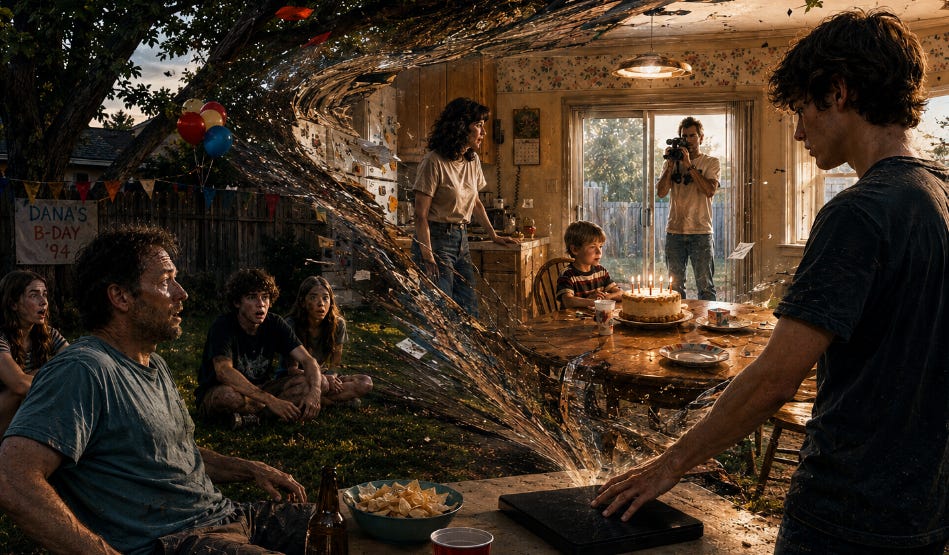
Then he picked it up and held it and didn’t do anything else, and Wes was about to ask what he was waiting for when the kitchen came up over the potato chips.
It was 1994 and it was four in the afternoon and the light was that specific yellow, the yellow of a wall that had been painted once in 1981 by people who thought it was cheerful. The cake was on the table with seven candles in it, and there he was in the little chair, and Wes’s throat did something before his brain had finished catching up.
“That’s — “ he said.
It wasn’t playing. It was standing there. He put his hand out and the kitchen was around his hand, and when he leaned, it let him lean; he moved his head and saw the cake from above, the frosting rippled where his mother had run out of patience with the spatula, and then he crouched slightly and was looking at the far wall, the one with the calendar and the phone cord going down to the floor, and he stopped.
There was no far wall. There had never been a far wall. His father shot that tape from the sliding door and everything that existed on it was what a man could see standing in a sliding door, and Wes had carried that file across four hard drives and two divorces and he knew every frame of it like a hymn.
He straightened up. His father was standing at the sliding door. From the front. Wes had not seen his father’s face in that kitchen in thirty-two years and here it was, a little jowly already, squinting into a viewfinder, and the reconstruction had put a wedding ring on the correct hand.
“How much of this is real?”
Ellis didn’t answer.
Off to the left, past the edge of the cake, his mother was standing at the counter not being filmed. Not smiling. Not doing anything. She had one hand flat on the countertop and she was looking at the middle of the room with an expression Wes had absolutely no file for — not tired, more like a woman standing very still to see if a noise happens again.
“That’s not — “ Wes said, and laughed, and heard the laugh come out wrong. “It’s guessing there. Right? There’s no source for that. It’s filling in.”
At the fence, the other three went still at the same time. Not looking up. Not looking at anything. Just three kids in the grass arriving at the same moment of stillness like a chord.
Dana was telling the husband about the roofers.
And then the kitchen thinned — not off, just thinner — and for less than a second there was the backyard in it. This backyard. The folding table with the chips and the cooler and the good citronella nobody had lit, and Wes at the end of it with his shoulders up around his ears, seen from somewhere above and slightly behind the pecan tree, where there was nothing, where nobody had ever put anything.
Then the kitchen was back, and the cake turned once more, patient, waiting for somebody to want something from it.
Ellis lowered the slab and the whole thing folded up into nothing at all.
Wes had a question ready. He’d had it ready for a while, actually — it had been assembling itself since Christmas, since the tall thing happened, and he opened his mouth to ask it and discovered that he’d already had it, start to finish, in his head, complete, and that saying it out loud would just be handing over a copy.
Ellis was looking at him. Not up at him — the kid had four inches on him now. Straight at him, and then a second past that, and then another one, the way your eyes stay on a page until you’ve got the whole sentence.
“Things today,” Ellis said, “are a bit more open ended.”
The words came out heavy, the way a stone goes into a pond, because he hadn’t spent any all afternoon and these had been sitting somewhere getting dense.
Wes stood there with the warm beer. The husband was saying something about gutters. His sister laughed at it. Out at the fence the four of them were arranged in the grass, not a circle, nobody facing anybody, and all four of them were looking at the same nothing.
Ellis grinned — the smallest grin there is, a quarter of one, gone almost before it arrived — and without turning, without a cue, without one of them so much as glancing over, the other three smiled with him.
Out in the nothing, in the silence, the world answered. It filled in the way the kitchen had filled in — the far wall first, then the angles nobody had ever seen, then the parts that had never been anywhere at all.
Wes sipped his beer; hot and flat. He spat it into the grass, turned and threw the bottle away. He lumbered back to the kitchen, where his sister was wiping some cake off of her youngest’s cheek, and grabbed a fresh beer from the fridge.